
Ordering sequence of events is simply listing events (of any textual piece) in the order in which they happened. The sequence of events of a typical morning might look like:
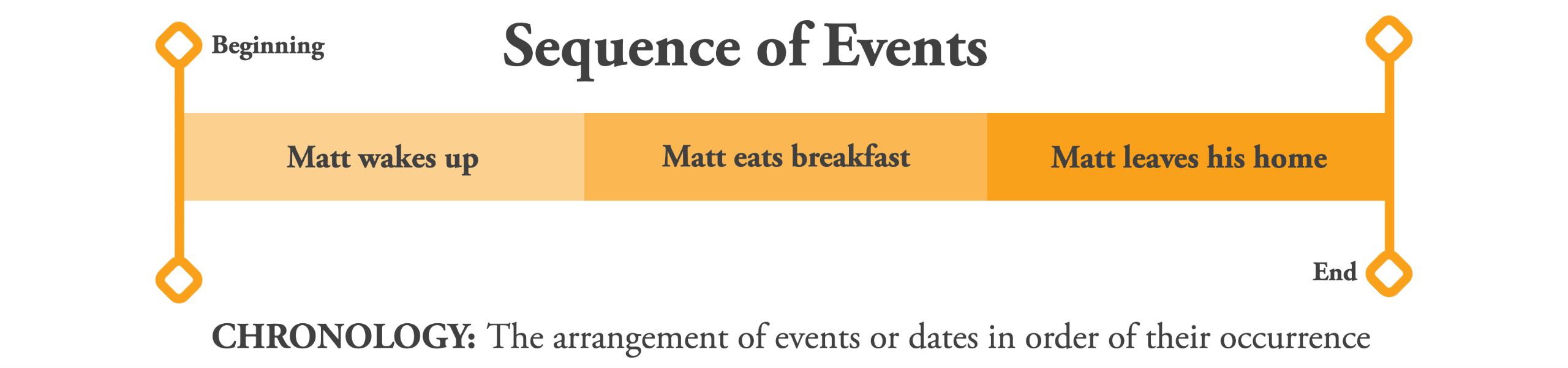
Since the above sequence of events is ordered using time (and not, for example, in order of what Matt enjoyed best about his morning), it is chronological.
Ordering sequence of events is incredibly useful because it helps you spot cause and effect relationships. In the above example, if Matt never woke up, the remainder wouldn’t be possible (unless it was an elaborate instance of sleepwalking). Similarly, you could misunderstand the climax of a story if you don’t connect the pieces leading up to it. Therefore, it’s important to analyze the connection and order of events.
| Keyword | Definition |
| Chronology | The arrangement of events or dates in order of their occurrence |
| Climax | The most intense, exciting, or important part of the story |
Sometimes an author may not give precise times for each event. The writer may indicate a chronological order through using transitional words like next, then, or finally.
I ran to the store. Then, I went to visit my grandmotherThen signifies an event after the initial sentence.
I jumped, skipped, and ran at the track meet. Finally, I walked home.The first sentence doesn’t actually indicate a chronological order between jumped, skipped, and ran. The next sentence, however, occurs after all three actions (because of the transitional word finally).
Practice:
Read the below excerpt from Moby Dick by Herman Melville. Then, answers the related questions underneath it.